


Definition
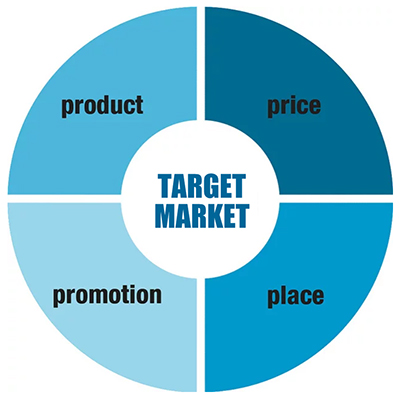
The 4 P’s of the Marketing Mix
Marketing mix refers to the combination of controllable marketing variables that the firm uses to pursue the desired level of sales in the target market.
The most common classification of these factors is the four-factor classification called the 4 Ps: product, price, promotion, and place (or distribution).
Optimization of the marketing mix is achieved by assigning the amount of the marketing budget to be spent on each element so as to maximize the total contribution to the firm. Contribution may be measured in terms of sales or profits or in terms of any other organizational goals.
Marketing mix models are used to determine the optimal marketing mix. They take into account the market response to the various marketing mix elements and their interactions. These models include econometric market response models to the marketing mix variables of the firm (and its competitors) as well as microsimulation models, various optimization models, and customized applications of the analytic hierarchy process and other resource allocation models.
In carry-over models, the effect of a marketing mix variable is assumed to last beyond a single time period (i.e., a lagged effect). [1]
Dominique Hanssens’ 2011 MASB white paper describes the phenomenon: “Carry-over effects reflect a delayed buyer response to advertising. Carry-over is not fundamentally different from immediate response; it is simply the result of ‘letting the dust settle’—a time shift in impact.” [2]
References
- American Marketing Association, AMA Dictionary.
- Hanssens, Dominique. What Is Known About the Long-Term Impact of Advertising. Marketing Accountability Standards Board, February 2011.